


hen the UN Secretary-General describes power moving from governments to companies and to technology, he is describing the room we have spent two decades trying to build. That is also the argument at the heart of my new book, "Everyone's Business." The long arc from the Millennium Development Goals to the Sustainable Development Goals opened solution-making to anyone willing to take it on: founders and philanthropists, educators and health leaders, technologists and citizens, working alongside governments. Signals House is where we put that argument into practice.
On the eve of the General Debate, we gathered on the rooftop at Aretsky's Patroon. We chose it because it asks for no UN credential at the door. Across Signal Salons on the future of education, philanthropy, health, and innovation and diplomacy, discerning leaders from every sector took on the question we kept returning to: Who delivers? Each Salon closed with a Statement of Signals, read aloud before anyone left the room.
Those Statements are the beginning of our work. In the coming weeks, they will become Signal Briefs, and we will carry them to Davos 2027 and beyond. The speeches are over, so what follows is what we heard and what we intend to do with it.
Ana C. Rold, CEO & Founder
Diplomatic Courier & World in 2050
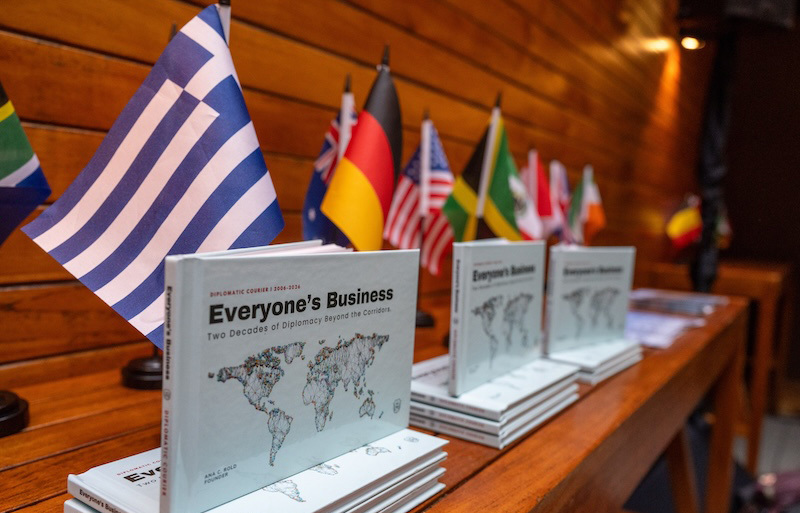
Everyone's Business
Two Decades of Diplomacy Beyond the Corridors.
In “Everyone’s Business,” founder Ana C. Rold traces the twenty-year history of Diplomatic Courier, following its evolution from magazine to convener to champion for a better kind of diplomacy in the 21st century.
Read the edition on our digital bookshelf here.
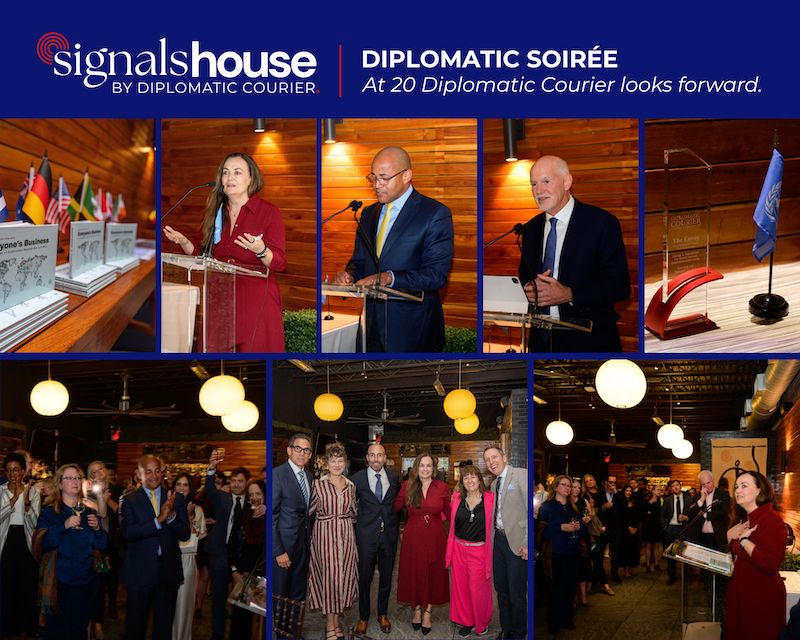
The Diplomatic Soirée
A New Envoy Joins the 2026 Class.
On the evening of September 21, which was also the International Day of Peace, we marked Diplomatic Courier's twentieth anniversary at tables named for the agreements that built the international order, from the Peace of Westphalia to the Treaty of Tlatelolco and the Paris Agreement. The night looked ahead to the next twenty years as much as back on the last. Guests left with copies of "Everyone's Business," printed small enough to fit in a carry-on. At the center of the evening was The Envoys, our awards programme that honors people who practice diplomacy without waiting for the title. Dante Disparte, Chief Strategy Officer at Circle, Diplomatic Courier board member and our original Envoy, passed the honor to former Greek Prime Minister and Symi Symposium founder George Papandreou, named The Bridge Builder.
"You Do Not Need a Title to Act"
Papandreou dedicated his remarks to his mother, Margarita, who passed away days before the Soirée. She was born in Illinois and made Greece her home. During the years of the dictatorship she traveled from parliament to parliament with no diplomatic credentials, and later she brought Greek and Turkish women together across the Aegean. "You do not need permission to care," he said, "and you do not need a title to act."
He traced that lesson through his own career. Soon after he became foreign minister, an earthquake struck Turkey, and he asked Greeks to help the neighbors they had been taught to fear. Within days, hospitals were turning donors away. Citizen initiatives between the two countries then multiplied so fast that his office stopped counting them. His lesson for today is that fear concentrates power and cooperation spreads it. This is a critical lesson at a time when no nation can govern climate, pandemics, or artificial intelligence alone.
His call to the room was concrete: a Truce Education Week in schools before each Olympic Games, building toward Los Angeles 2028, the French Alps 2030 and Brisbane 2032, so young people learn to hold the peace. The choice, he said, is between two inheritances from the ancient world, the Olympic spirit and the Roman arena. "Someone must begin the conversation. Someone must cross the divide, and every one of us can be that person."
A note of gratitude: Signals House and the Diplomatic Soirée were made possible by the National Center on Education and the Economy (NCEE), Cambridge University Press & Assessment, the Learning Economy Foundation, PVBLIC Foundation, Circle, Global Philanthropy Forum, APCO, StrategEast, and Philip Morris International. We are grateful to every speaker, partner, and guest who joined and supported us.
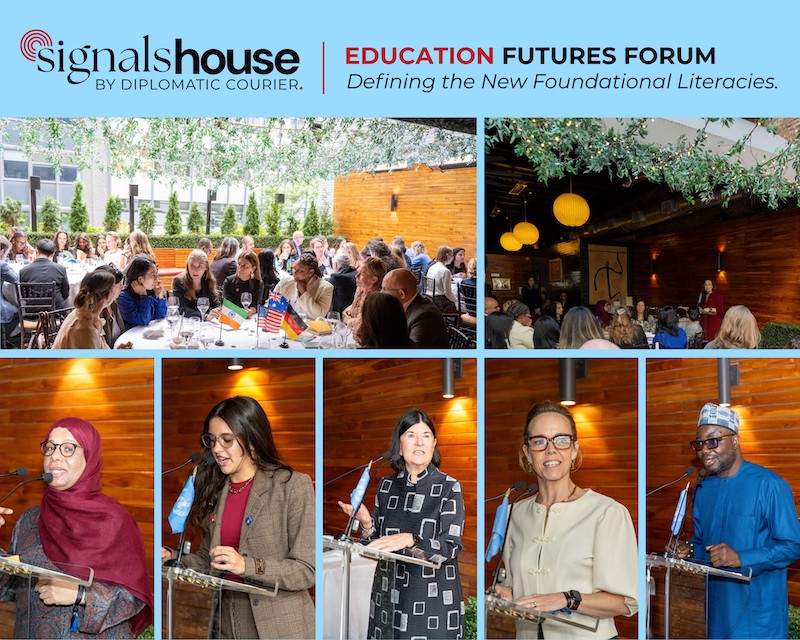
Education Futures Forum
The next education divide will separate learners taught to judge AI from learners taught only to use it.
Dr. Asyia Kazmi of WISE opened with the foundations. In low-income countries, nine in ten children cannot read a simple text by age ten. Places like Sobral in Brazil show that political will, structured teaching, and steady measurement can change that within a few years. Jane Mann of Cambridge University Press & Assessment argued that systems thinking should be taught as a literacy in its own right, built on deep subject knowledge. Dr. Vicki Phillips of NCEE warned that AI could become "the newest version of an old divide," with some students invited to shape the future while others are taught to function within it.
UN Youth Ambassador Zoya K. then turned the question back on the room. She asked everyone under 18 to raise a hand. She challenged the adults to ask whether young people are being heard or whether we have simply become "very, very good at speaking about them." Drawing on the United Youth Council she founded, which connects young people in more than 60 countries, she argued that education should be a place to practice, where students take on real problems, real disagreements, and real responsibility. The literacy she would add to the list is the ability to understand the world and influence it, because knowledge alone "can prepare them to navigate the future," while opportunity prepares them to shape it.
Over lunch, the tables pushed further. They asked for young people as co-creators of reform from start to finish, for schools that teach human skills before they hand over the tools, and for leaders who invest in teachers first.
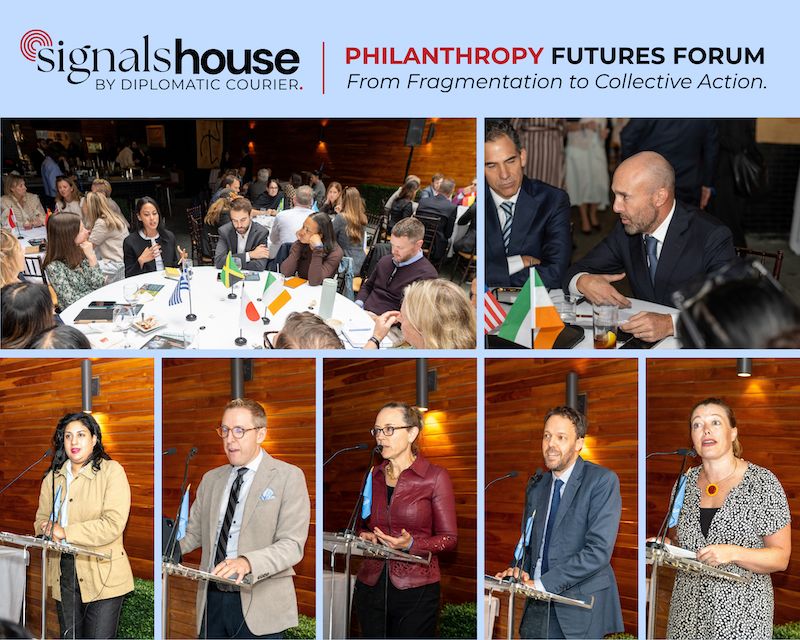
Philanthropy Futures Forum
The world has enough well-intentioned capital. What it lacks is the shared language, infrastructure, and courage to make that capital consequential.
Jessie Krafft of CAF America grounded the room in the World Giving Report. Six in ten people worldwide gave money in 2025. Eight of the ten most generous countries are in Africa, and every one of the ten is low- or lower-middle-income, with citizens giving more than twice the global average as a share of their income. The strongest predictor of generosity was belonging, well ahead of wealth. The charities that turn that generosity into impact are straining, though: two-thirds report rising demand, and fewer than two in five feel able to sustain themselves over the next three years.
Three provocations followed:
Princess Jahnavi Kumari Mewar of JPM Capital proposed "convergence philanthropy." It starts from a defined human outcome, matches each kind of capital to the obstacle it can move, and recycles philanthropic money once a solution can stand on its own.
Blair Glencorse of Accountability Lab argued that accountability is a relationship rather than a compliance exercise, and that consultation alone does not amount to accountability. He also argued that the risks funders take should grow with the power they hold. He left the room with one question: "Are you trying to solve a problem, or are you just making a grant?"
John Goodwin of the Learning Economy Foundation asked funders to share strategy, attribution, and control. He also called for impact consolidators to end the sector's fragmentation, and for shared public goods such as the open-source infrastructure his team is building with Nigeria.
Elisabeth Carpenter of Circle then responded to all three. She urged funders to back the unglamorous infrastructure that lets nonprofits do more with less.
At the tables, the signals converged. One table called for a common language of measurement, "an operating system for public purpose." Another described "tide pool infrastructure" to sustain the life that remains in the sector now that the political and financial tide has gone out. A third argued for localized, trust-based funding with a gender lens. The last table named its signal in two words, "intentional collaboration," and added that funders should be brave and use the tension.
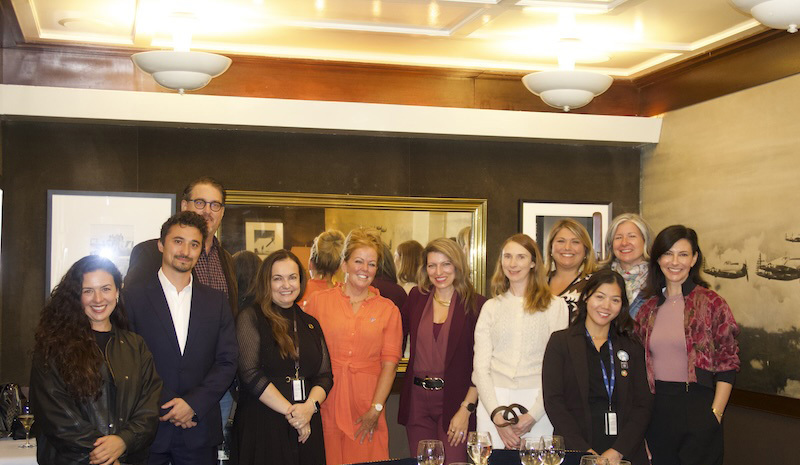
Collaboration for Climate & Health Impact
During UNGA 81 and Climate Week NYC, Ana C. Rold of Diplomatic Courier, Daniella Foster of Bayer, and Dr. Sally Uren of Forum for the Future brought leaders from consumer goods and healthcare to Signals House for a private roundtable. This is the third annual meeting convened by the hosts at UNGA. The question on the table this year was how to advance human wellbeing and planetary health together, at a moment when climate pressure is rewriting the conditions for health faster than institutions can adapt. The meeting was off the record, but the group agreed to publish a Signal Brief together in the near future.
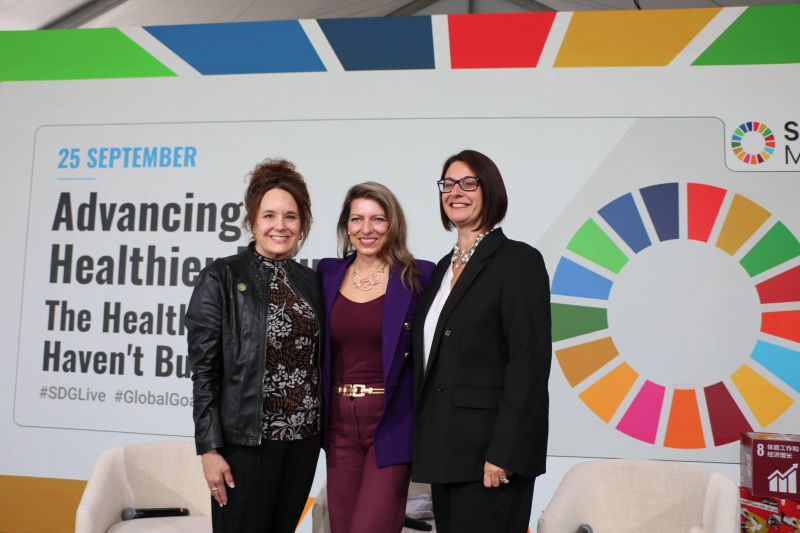
Advancing Healthier Futures at the SDG Media Zone
Health systems are in distress. As Valérie Boulet of the WHO Foundation noted, 4.6 billion people still lack full coverage of essential health services, and the world faces a shortage of more than 10 million health workers by 2030. Daniella Foster of Bayer added that half the world spends less than five minutes a year with a doctor, which makes evidence-based self-care "a first and last line of care." The conversation, moderated by Diplomatic Courier's Pam Kelley Lauder, focused on interventions such as HPV and HIV self-testing, home monitoring for diabetes and blood pressure, and prenatal micronutrients, which return $37 for every dollar invested. The speakers also pointed to one key condition: self-care has to be built into national health systems and fully funded as part of universal health coverage, and it should never become an excuse for governments to step back. Zambia, which already includes self-tests in its national health package, shows what that can look like.
Watch the UN Web TV replay here.
What Comes Next?
Every Forum at Signals House ended with homework, and this closing section is ours. Over the coming weeks, we will turn each Statement of Signals into a Signal Brief, and we will reach out to you for your input. From there, the signals travel with us to Davos and beyond. The speeches are over, and the work continues with everyone who was in the room.
Sign up to receive the Signal Briefs
AI disclosure note: AI [Claude Sonnet 5.5] assisted in the outline process of this article.
Learn more: diplomaticourier.com/ai-transparency


a global affairs media network
UN General Assembly 81: After the Speeches
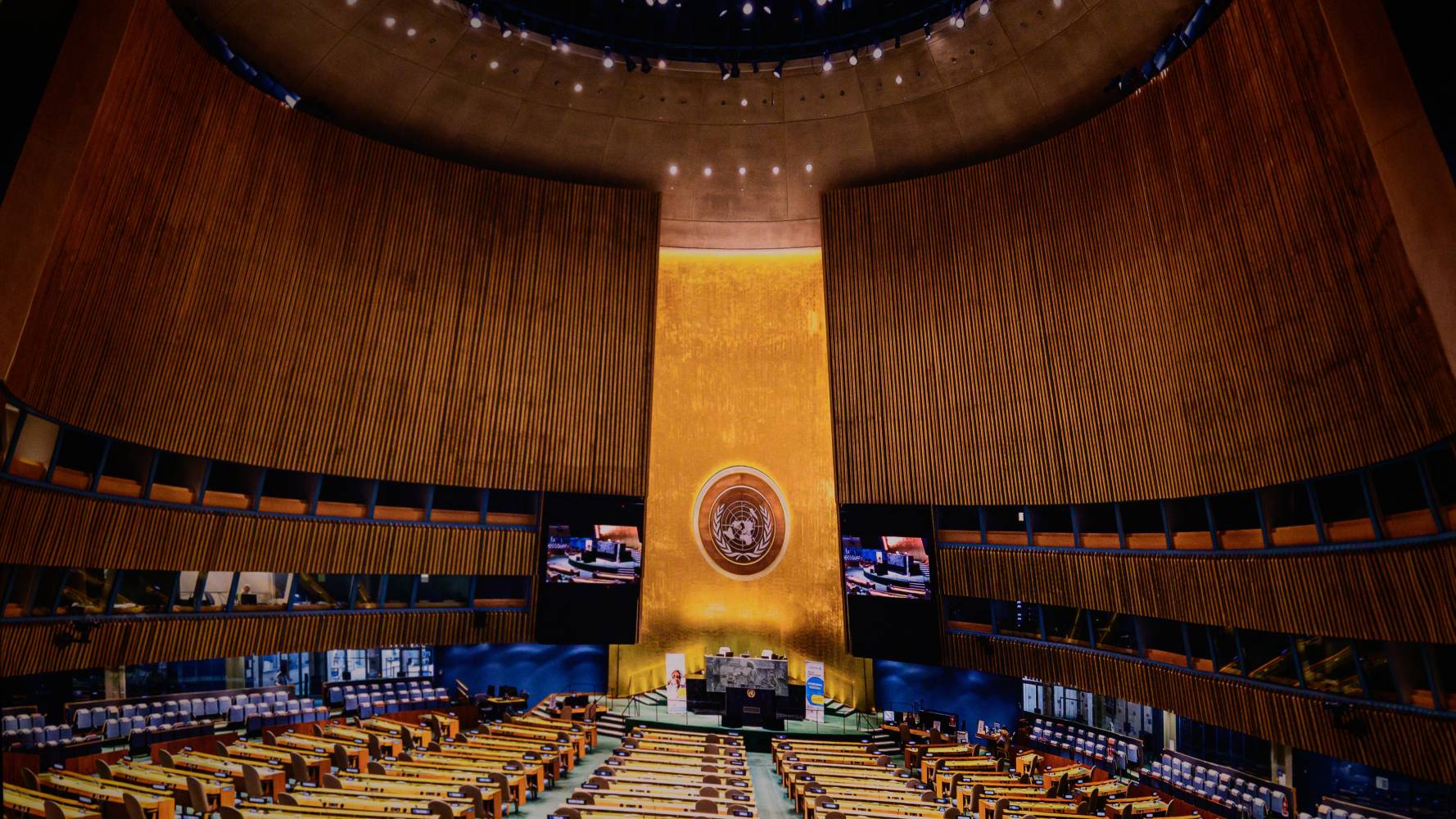
UN General Assembly immediately before the beginning of the General Debate. Photo by Marcellus McIntosh for Diplomatic Courier.
September 29, 2026
The UN Secretary-General recently named a trend that Diplomatic Courier has spent two decades working through: power is moving away from governments toward board rooms and tech. Our efforts to ensure that evolution arrives well continued at UNGA this year, writes Ana C. Rold.
W
hen the UN Secretary-General describes power moving from governments to companies and to technology, he is describing the room we have spent two decades trying to build. That is also the argument at the heart of my new book, "Everyone's Business." The long arc from the Millennium Development Goals to the Sustainable Development Goals opened solution-making to anyone willing to take it on: founders and philanthropists, educators and health leaders, technologists and citizens, working alongside governments. Signals House is where we put that argument into practice.
On the eve of the General Debate, we gathered on the rooftop at Aretsky's Patroon. We chose it because it asks for no UN credential at the door. Across Signal Salons on the future of education, philanthropy, health, and innovation and diplomacy, discerning leaders from every sector took on the question we kept returning to: Who delivers? Each Salon closed with a Statement of Signals, read aloud before anyone left the room.
Those Statements are the beginning of our work. In the coming weeks, they will become Signal Briefs, and we will carry them to Davos 2027 and beyond. The speeches are over, so what follows is what we heard and what we intend to do with it.
Ana C. Rold, CEO & Founder
Diplomatic Courier & World in 2050
Everyone's Business
Two Decades of Diplomacy Beyond the Corridors.
In “Everyone’s Business,” founder Ana C. Rold traces the twenty-year history of Diplomatic Courier, following its evolution from magazine to convener to champion for a better kind of diplomacy in the 21st century.
Read the edition on our digital bookshelf here.
The Diplomatic Soirée
A New Envoy Joins the 2026 Class.
On the evening of September 21, which was also the International Day of Peace, we marked Diplomatic Courier's twentieth anniversary at tables named for the agreements that built the international order, from the Peace of Westphalia to the Treaty of Tlatelolco and the Paris Agreement. The night looked ahead to the next twenty years as much as back on the last. Guests left with copies of "Everyone's Business," printed small enough to fit in a carry-on. At the center of the evening was The Envoys, our awards programme that honors people who practice diplomacy without waiting for the title. Dante Disparte, Chief Strategy Officer at Circle, Diplomatic Courier board member and our original Envoy, passed the honor to former Greek Prime Minister and Symi Symposium founder George Papandreou, named The Bridge Builder.
"You Do Not Need a Title to Act"
Papandreou dedicated his remarks to his mother, Margarita, who passed away days before the Soirée. She was born in Illinois and made Greece her home. During the years of the dictatorship she traveled from parliament to parliament with no diplomatic credentials, and later she brought Greek and Turkish women together across the Aegean. "You do not need permission to care," he said, "and you do not need a title to act."
He traced that lesson through his own career. Soon after he became foreign minister, an earthquake struck Turkey, and he asked Greeks to help the neighbors they had been taught to fear. Within days, hospitals were turning donors away. Citizen initiatives between the two countries then multiplied so fast that his office stopped counting them. His lesson for today is that fear concentrates power and cooperation spreads it. This is a critical lesson at a time when no nation can govern climate, pandemics, or artificial intelligence alone.
His call to the room was concrete: a Truce Education Week in schools before each Olympic Games, building toward Los Angeles 2028, the French Alps 2030 and Brisbane 2032, so young people learn to hold the peace. The choice, he said, is between two inheritances from the ancient world, the Olympic spirit and the Roman arena. "Someone must begin the conversation. Someone must cross the divide, and every one of us can be that person."
A note of gratitude: Signals House and the Diplomatic Soirée were made possible by the National Center on Education and the Economy (NCEE), Cambridge University Press & Assessment, the Learning Economy Foundation, PVBLIC Foundation, Circle, Global Philanthropy Forum, APCO, StrategEast, and Philip Morris International. We are grateful to every speaker, partner, and guest who joined and supported us.
Education Futures Forum
The next education divide will separate learners taught to judge AI from learners taught only to use it.
Dr. Asyia Kazmi of WISE opened with the foundations. In low-income countries, nine in ten children cannot read a simple text by age ten. Places like Sobral in Brazil show that political will, structured teaching, and steady measurement can change that within a few years. Jane Mann of Cambridge University Press & Assessment argued that systems thinking should be taught as a literacy in its own right, built on deep subject knowledge. Dr. Vicki Phillips of NCEE warned that AI could become "the newest version of an old divide," with some students invited to shape the future while others are taught to function within it.
UN Youth Ambassador Zoya K. then turned the question back on the room. She asked everyone under 18 to raise a hand. She challenged the adults to ask whether young people are being heard or whether we have simply become "very, very good at speaking about them." Drawing on the United Youth Council she founded, which connects young people in more than 60 countries, she argued that education should be a place to practice, where students take on real problems, real disagreements, and real responsibility. The literacy she would add to the list is the ability to understand the world and influence it, because knowledge alone "can prepare them to navigate the future," while opportunity prepares them to shape it.
Over lunch, the tables pushed further. They asked for young people as co-creators of reform from start to finish, for schools that teach human skills before they hand over the tools, and for leaders who invest in teachers first.
Philanthropy Futures Forum
The world has enough well-intentioned capital. What it lacks is the shared language, infrastructure, and courage to make that capital consequential.
Jessie Krafft of CAF America grounded the room in the World Giving Report. Six in ten people worldwide gave money in 2025. Eight of the ten most generous countries are in Africa, and every one of the ten is low- or lower-middle-income, with citizens giving more than twice the global average as a share of their income. The strongest predictor of generosity was belonging, well ahead of wealth. The charities that turn that generosity into impact are straining, though: two-thirds report rising demand, and fewer than two in five feel able to sustain themselves over the next three years.
Three provocations followed:
Princess Jahnavi Kumari Mewar of JPM Capital proposed "convergence philanthropy." It starts from a defined human outcome, matches each kind of capital to the obstacle it can move, and recycles philanthropic money once a solution can stand on its own.
Blair Glencorse of Accountability Lab argued that accountability is a relationship rather than a compliance exercise, and that consultation alone does not amount to accountability. He also argued that the risks funders take should grow with the power they hold. He left the room with one question: "Are you trying to solve a problem, or are you just making a grant?"
John Goodwin of the Learning Economy Foundation asked funders to share strategy, attribution, and control. He also called for impact consolidators to end the sector's fragmentation, and for shared public goods such as the open-source infrastructure his team is building with Nigeria.
Elisabeth Carpenter of Circle then responded to all three. She urged funders to back the unglamorous infrastructure that lets nonprofits do more with less.
At the tables, the signals converged. One table called for a common language of measurement, "an operating system for public purpose." Another described "tide pool infrastructure" to sustain the life that remains in the sector now that the political and financial tide has gone out. A third argued for localized, trust-based funding with a gender lens. The last table named its signal in two words, "intentional collaboration," and added that funders should be brave and use the tension.
Collaboration for Climate & Health Impact
During UNGA 81 and Climate Week NYC, Ana C. Rold of Diplomatic Courier, Daniella Foster of Bayer, and Dr. Sally Uren of Forum for the Future brought leaders from consumer goods and healthcare to Signals House for a private roundtable. This is the third annual meeting convened by the hosts at UNGA. The question on the table this year was how to advance human wellbeing and planetary health together, at a moment when climate pressure is rewriting the conditions for health faster than institutions can adapt. The meeting was off the record, but the group agreed to publish a Signal Brief together in the near future.
Advancing Healthier Futures at the SDG Media Zone
Health systems are in distress. As Valérie Boulet of the WHO Foundation noted, 4.6 billion people still lack full coverage of essential health services, and the world faces a shortage of more than 10 million health workers by 2030. Daniella Foster of Bayer added that half the world spends less than five minutes a year with a doctor, which makes evidence-based self-care "a first and last line of care." The conversation, moderated by Diplomatic Courier's Pam Kelley Lauder, focused on interventions such as HPV and HIV self-testing, home monitoring for diabetes and blood pressure, and prenatal micronutrients, which return $37 for every dollar invested. The speakers also pointed to one key condition: self-care has to be built into national health systems and fully funded as part of universal health coverage, and it should never become an excuse for governments to step back. Zambia, which already includes self-tests in its national health package, shows what that can look like.
Watch the UN Web TV replay here.
What Comes Next?
Every Forum at Signals House ended with homework, and this closing section is ours. Over the coming weeks, we will turn each Statement of Signals into a Signal Brief, and we will reach out to you for your input. From there, the signals travel with us to Davos and beyond. The speeches are over, and the work continues with everyone who was in the room.
Sign up to receive the Signal Briefs
AI disclosure note: AI [Claude Sonnet 5.5] assisted in the outline process of this article.
Learn more: diplomaticourier.com/ai-transparency


