


ver the past year, the Democracy, Rights, and Governance (DRG) community has operated under dramatically changed funding conditions that have reshaped timelines, partnerships, and operating assumptions. Aid cuts have exposed and accelerated pressures that had been accumulating for some time, undermining the connective tissue between various organizations and increasing misalignment between funding architectures and democracy work.
Multiple diagnostics, surveys, essays, and convenings have since documented the effects of these shifts at personal, organizational, and system levels. Taken together, they point less to collapse than to uneven adaptation. Some work seems to have continued because it was already locked into technocratic cycles or protected by standing commitments. Other work persisted because it was relationally embedded, loosely coordinated, and able to recombine under pressure. The distinction matters—not as a judgment of value, but as a signal about where viability emerged under constraint.
This memo takes stock of what the past year has revealed in practice and asks a forward–looking question: Where and how can aid and philanthropic leadership support the DRG space, given these realities and emergent signals from the field? Our intent is not to offer a new model, but to identify patterns and possibilities that quietly but consistently surfaced over the past year across contexts where the margin for error was narrow and the cost of inaction real.
This memo is complemented by a separate practice–focused reflection that documents how Accountability Lab and its partners navigated these dynamics over the past year, given the conditions described here.
Editors’ Note: This white paper was authored by Florencia Guerzovich, PhD, for Accountability Lab. Report production and editorial support provided by Diplomatic Courier’s think tank, World in 2050.
Where we are
In early 2025, Accountability Lab, Humentum, and Global Voices jointly created the Global Aid Freeze Tracker to document the human and societal effects of bilateral and multilateral cuts. Drawing on input from more than 1,400 respondents across the world, the tracker highlights common effects: abrupt program suspensions; erosion of core organizational capacity; and loss of experienced staff. Between January and March 2025 the first two surveys showed consistent financial impact with many respondents reporting 60% to 100% of their budgets affected. The third survey in May painted a slightly better picture although this may have been because some organizations had already closed. By this time, more than 60% of respondents had not found alternate revenue sources, and the same percentage had furloughed staff.
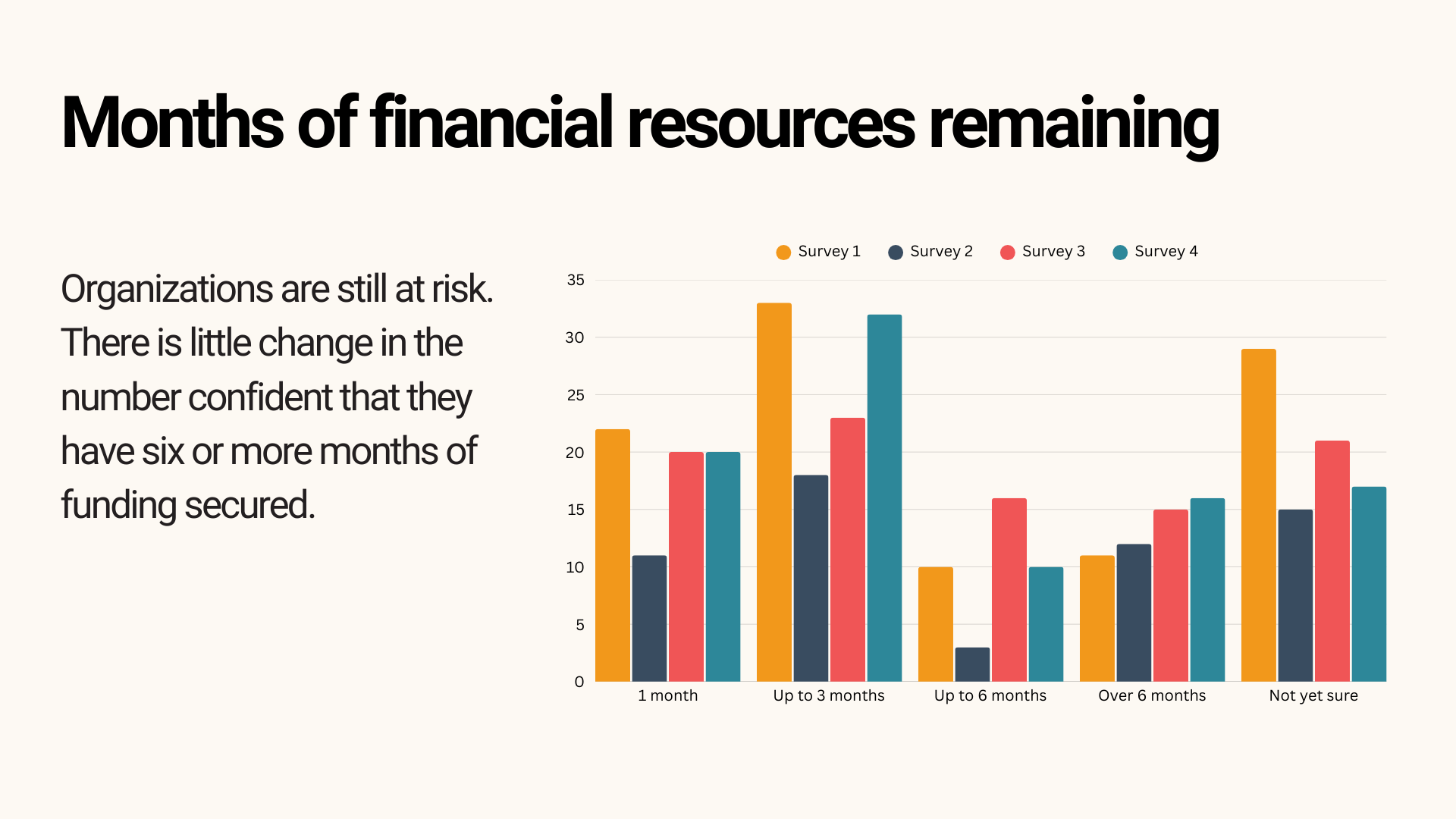
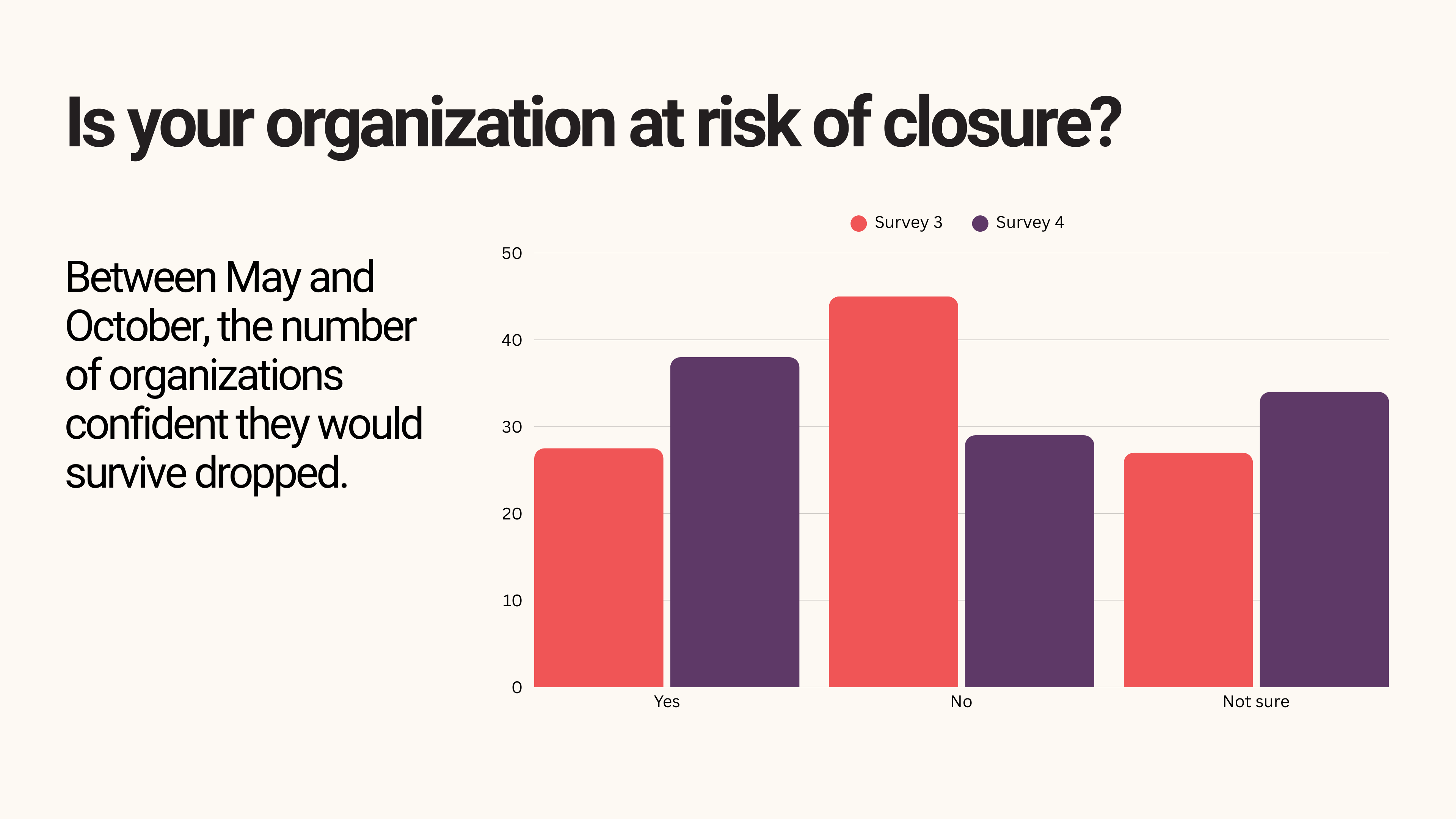
Organizations still standing by October strongly indicated continued volatility in the sector and possible risk of closure. Many reported providing services for alternative revenue, and 64% were either actively seeking or considering mergers or other partnerships.
Complementary regional analyses reinforce this picture while clarifying where the pressure now sits. For example, analysis of the sector in the Indo-Pacific region invites civic actors, donors and their allies to leave behind outdated, often rose–tinted frameworks and revisit how civil society is valued and supported. In Africa, surveys by @AfricanNGOs and EPIC–Africa of 364 CSOs across 42 countries document acute disruption alongside strong appetite for collaboration, with 93.8% of respondents expressing willingness to work collectively, perhaps. In Latin America, Civic House describes a civic sector operating between professionalization and fragility—capable, but structurally exposed—while emphasizing coalition-building and strategic alliances as central to financial sustainability and defense of civic space. Case analyses in Ukraine and Serbia similarly show organizations maintaining essential functions under pressure, but postponing the kind of strategic rethink required to adapt to altered political and funding realities.
Taken together, these diagnostics seem to point to a missing layer of connective and reflective infrastructure—spaces, practices, and support mechanisms that allow collective action to remain effective in meeting the moment. We have begun to call some of these spaces Tidepool Infrastructures: They fill gaps in the ecosystem until the tide comes back. They also point to the need to shift from talk to feasible action—while acknowledging that any “returning tide” may look different from the past: in scale, shape, and expectations.
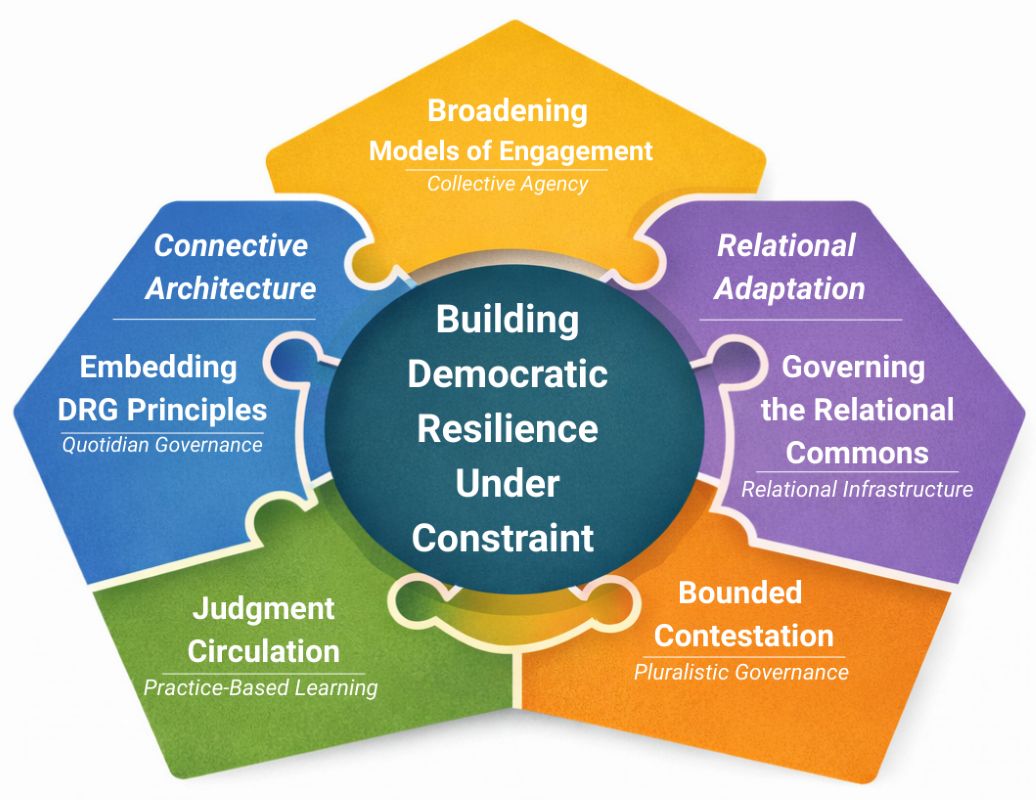
The following pillars distill learning that emerged from this experience. They are not mutually exclusive, nor do they constitute a blueprint. Together, they point to practical places where aid and philanthropy can reinforce ways of working that show viability and promise under constraint.
Pillar 1: Broadening models of engagement
The past year points less to the superiority of any single collaborative form and more to the importance of expanding the range of engagement models through which DRG actors can credibly engage.
During political volatility, effectiveness depends less on whether actors organize as formal coalitions, networks, multi–stakeholder platforms, or partnerships, and more on whether engagement arrangements allow actors to reposition, recombine, and coordinate without being locked into rigid structures or lowest–common–denominator alignment. In short, collective flexibility is critical. This suggests a shift away from prioritizing specific organizational forms and processes toward investing in the conditions that enable coherence and collective action across differences. Complexity–informed approaches recognize that not all actors need to act in the same way, at the same time, or toward identical objectives to develop and sustain momentum. Leveraging the diversity across parts creates an approach that is more than the sum of those parts.
What matters is the availability of relevant engagement architectures—from informal coordination and time–bound alliances to more structured coalitions when incentives and political conditions support them. Across this spectrum, fit and future–readiness to implement viable options for action matter more than permanence or formality.
If democracy advocates want diverse actors to remain in contact and collaborate when formal programs falter, funders and ecosystem stewards cannot assume it will self–organize. They must intentionally work toward that outcome—and resource it—rather than assuming it will self–organize. This is a collective action problem: no single organization can justify paying the full cost of coordination when the benefits spill over to the whole field. So the practical move is to invest in agents and platforms that can coordinate under stress—not just in individual organizations operating alone. Recent work across philanthropy and governance support points in the same direction: connect across civil society silos and bring other public and private stakeholders into the picture. The throughline is simple: Connective roles, spaces, and catalytic capacity are enabling infrastructure for collective action.
Case study: Expanding engagement architectures
Case study: Expanding engagement architectures
In late 2024, the Dominican government, with World Bank support, convened an International Civil Society Congress bringing together local organizations, regional actors, and national leadership. The convening positioned civil society as a strategic partner in national development while providing a range of insights of practical interest to voluntary service delivery groups who often rely on local philanthropy as well as policy advocacy ones that might rely on aid. In spirit, the model built on a tradition in the country of investing in Coalitions for Reform. Its value lay less in specific outputs than in its function: an innovative space that enabled a refreshed exchange across roles, seniority levels, and perspectives without predetermining alignment or outcomes.
In the United States, the Horizons Project has played a related leadership role by internationally convening and facilitating engagement across a “big tent” group of organizations while also connecting adjacent coalitions, working groups and leaders. Its relevance to this publication is not any particular agenda or framework, but its function as connective infrastructure. The focus on the critical lines of contact, shared reference points, and working relationships across a fragmented field during periods of heightened polarization and institutional stress, builds on years of peacebuilding and bridge–building experience elsewhere.
The #ShiftthePower movement and Summit is another example of an effort to bring civil society, development actors, and philanthropy together to allow for “good collisions.” While its normative agenda is central for many, its relevance to this discussion lies in creating space to lift up and proximate organizations and build connective glue across roles rather than supporting processes in themselves or prescribing approaches.

For aid and philanthropic actors, the implication is not to abandon technical programming or formal partnerships, but to rebalance portfolios to include investment in enabling functions: convening capacity, trusted boundary–spanners and weavers, flexible platforms, and connective work. In constrained environments, these investments expand what is possible—not by prescribing solutions, but by keeping pathways for coordination, learning, and joint action open as conditions evolve (also see Pillar 4). A companion piece provides a detailed menu of financial and non–financial support options.
Pillar 2: Embedding DRG principles
The current moment has reopened a long–running question in democracy and governance support: whether—and how far—to look beyond democracy as a standalone organizing narrative.
While much recent debate has focused on integrating DRG concerns into global policy agendas, the past year underscored a complementary and simple insight: DRG principles are often most visible and valued when embedded in the everyday domains where people experience governance directly—whether in DRC, Hungary, Ukraine, or Brazil.
Across regions, practitioners point to forms of “quotidian governance”—dialogue, accountability, social trust, and problem–solving—built around livelihoods, health, education, water and sanitation, security, housing, and local service delivery. Consider the work of ANSA Africa, for example, which creates spaces for citizens to track government performance on education among other issues; Janaagraha, which supports citizens to provide feedback on public services in India; Akatiga, which empowers citizens to strengthen health systems in Indonesia and ACIJ, which works to better urban slums and improve access to housing in Argentina. In these spaces, DRG principles function less as abstractions and more as practical tools for activating human agency, engagement, connectedness, and shared purpose as well as managing conflict and sustaining cooperation.
This perspective also challenges narrow framings of civil society. Many organizations operate as service providers, intermediaries, professional associations, or hybrid actors rather than advocates alone. Many individual connectors perform important functions across organizations and sectors. It also suggests pro–democracy activists need to work much more closely with reformers within government at local levels who can work with those outside to build the “insider–outsider” (loose) coalitions that can create change. When democracy support overlooks these actors because they do not fit prevailing DRG categories, it misses critical entry points for relevance, legitimacy, efficacy and scale.
For aid and philanthropic actors, the implication is not to lower ambition, but to ground it in the sectors, assets, and relationships communities prioritize. This requires treating the DRG portfolio as a team sport—where success often means providing an assist rather than scoring the goal—and reconnecting with actors who sustain democratic practice even when formal institutions and funding come under strain.
Pillar 3: Learn from the Wayfinder perspective
A third, cross–cutting pillar is those setting DRG strategy—funders, intermediaries, and field leaders— are better served starting not with new technical toolkits, but with those who have long specialized in key aspects of DRG work.
A wayfinder perspective directs attention to organizations and leaders who have sustained democratic practice over time—often outside the spotlight of large–scale programs and famous frameworks.
These actors matter not simply because they are local, but because they hold practice–based knowledge about how specific elements of the DRG agenda are implemented within real constraints. Many approaches now gaining renewed global attention—decentralized funding, narrative power, and local information ecosystems—are not new discoveries for wayfinders, but long–refined practices.
Listening to wayfinders strengthens strategic judgment by grounding decisions in sustained experience. For funders, this means ensuring that insights from experienced practitioners are used when agendas are shaped—not brought in later to illustrate already established strategies.
Case study: Civil Society Wayfinders
Case study: Civil Society Wayfinders
The Civil Society Wayfinder campaign offers one illustration of how this perspective can be operationalized. Its contribution lies not in recognition alone, but in recalibration—connecting sector–wide debates about the future of democracy support with organizations whose experience can validate, challenge, or refine those debates. In doing so, it helps narrow the proximity gap between long–term strategic rethinking and the day–to–day DRG work that has continued, often quietly, over many years.
Pillar 4: Governing the relational commons
Many of the sector’s most consequential challenges cannot be solved organization by organization.
Civil society faces a classic “tragedy of the commons” problem. A November 2025 TAI convening underscored that this challenge shows up across the funding ecosystem: people inside and outside funding organizations often recognize the same bottlenecks, but they lack shared forums, incentives, and working mechanisms to address them together. The result is predictable—signals stay fragmented, frustrations get recycled in parallel conversations, and practical fixes that require joint action rarely stick.
What the past year of disrupted DRG funding revealed is the need for dedicated supporting roles (or “sidekicks”) that enable the system to function more coherently. These roles go by many names in the field: intermediaries, catalysts, backbone organizations, orchestrators, weavers, systems conveners and more. What matters is not the label, but the function they perform. Their contribution lies in supporting groups and ecosystems to adapt and learn together. In practice, these connective functions are often pulled toward the simplest to oversee and contract: uniform metrics, standardized processes, pre–agreed theories of change. This tendency dilutes responsiveness to context and undermines the very relational capacity the commons depends on. When funders and intermediaries treat these sidekick roles as instruments to manage collective impact—rather than to enable coordination—coordination costs are absorbed privately while benefits accrue publicly. Over time, this weakens collective capacity.
In contrast, relational commons governance features fit–for–context sidekicks and soft infrastructure that enable actors to make better political judgments under pressure, leveraging systems intelligence. Doing so successfully depends on capabilities that preserve variation while enabling coordination, such as:
- Lateral platforms: Allowing experience and judgment to circulate in smarter ways rather than being extracted upward for donor reporting.
- Dynamic nesting: Routines that allow diverse actors to understand and work with the "rules of the game," ensuring that coordination doesn't flatten local diversity.
- Trusted brokering: Intermediaries who connect scattered “democratic neurons,” acting as "stewards of the commons," helping actors access options and insights they could not reach alone.
- Stewardship of intent: Ensuring that coordination doesn't collapse into a "lowest–common–denominator" agreement or group–think, but remains focused on the high–leverage organizational choices that contribute to systems change.
For aid and philanthropic actors, this implies shifting investment from isolated units (tools, projects, brands, campaigns, organizations, etc.) to maintaining the commons, by supporting intermediaries, spaces, or platforms that steward coherence without prescribing practice or forcing premature alignment. It requires resisting the impulse to manage complexity by substituting lowest–common–denominator rules for context–sensitive judgment, instead backing institutional forms that can accommodate difference while enabling collective action.
The moment also calls for more intentional institutional nesting—building layers of support that recognize and work with the multi–dimensional expertise and the range of perspectives already present across the system. The November 2025 TAI convening surfaced a practical constraint: Shared infrastructure only works when funders and partners build enough common understanding to use it well, without defaulting to simplification. At this moment, it returns us to the idea of tidepool infrastructure: modest but well–positioned mechanisms that sustain life, learning, and connection while conditions remain constrained. This is not merely a response to a temporary low tide. The tide may return in a different form than before, but it will likely be the same ocean—so the system still needs connective infrastructure that preserves and maximizes collective capacity and systems intelligence across cycles, rather than rebuilding them from scratch each time conditions change.
Pillar 5: Working across disagreement
Stakeholders are increasingly aware that sustaining democratic governance requires working across disagreement rather than designing systems that assume (and thereby require) preconditions of alignment.
Disagreement is not a failure of democracy; it is one of its constitutive conditions. People will vote differently, advance competing claims, and contest priorities often sharply and unevenly, shaped by power, history, and exclusion. Sectoral peers will not adopt shared playbooks wholesale. These realities are not coordination problems to be engineered away, nor deviations to be disciplined, but conditions that democratic systems must be able to nurture and host without themselves falling apart.
Pluralistic governance does not require agreement on politics or policy. It requires something more basic: sustained commitment to a shared democratic playing field—institutions, norms, and practices that keep participation open and contestation legitimate. Outcomes are negotiable and even reversible. When harmony becomes the goal, however, disagreement is moralized or suppressed rather than worked through. Ideas are stifled, doubt wanes, narratives harden, feedback loops narrow. Groupthink replaces deliberation. In these conditions, politics does not disappear; it fragments. Even systems–oriented governance approaches have at times reproduced this logic, funding collaboration only once unity can be performed and treating dissent as a risk rather than a democratic signal.
Harmony–as–precondition approaches erase conflicting options. Democratic resilience can only be built through the relational capacity to recognize and work through those conflicts. This is not about flattening power or treating all positions as equivalent. It is about sustaining the institutional conditions as well as the relationships and micro–skills that allow disagreement to remain political rather than existential—contested, but bounded.
In practice, this work happens in sites—concrete arenas such as community institutions, sectoral platforms, etc—rather than being confined to formal or national–level political spaces. These localized sites may have an edge over national or international ones for this kind of problem solving, not because they presume consensus, but because disagreement is anchored in lived consequences and the need to keep things functioning. Some examples of localized–site successes include:
- The Wajir Peace and Development Committee (WPDC) in Kenya, which brings together women, elders, young people, religious leaders, and government officials to build trust across deeply divided clans.
- The Asociacion de Trabajadores Campesinos del Carare in Colombia, a village–based organization that has built significant collective trust and community accountability, even in times of conflict.
- MdSC in Benin, which provides a structured arena for negotiation, information–sharing, and collective representation, illustrating how plural actors can work across disagreement while preserving organizational autonomy.
This brings us back to Pillar 2: embedding democratic principles in the everyday domains where people already negotiate differences, rather than treating alignment as a precondition for engagement.
For aid and philanthropic actors, the implication is not to fund depoliticized bridge–building or neutral brokerage, but to protect democratic systems at their core. This means investing in actors, practices, and connective infrastructure that sustain engagement across difference while safeguarding the rules of the democratic game itself—especially in contexts of polarization, inequality, and shrinking civic space. It also requires greater honesty within the DRG field: working more deliberately with internal diversity and disagreement. This approach recognizes that pluralism is not a moral stance but a practical requirement for keeping democratic governance functional when consensus is neither possible nor desirable.
Conclusion
Taken together, these five pillars define a reframing of resilience under constraint for the DRG community. The work that remained viable over the past year was not always the most visible or formally protected, but it was the work that was relationally embedded, adaptively coordinated, and grounded in lived practice. The opportunity now for funders, intermediaries, and field leaders is not to invent anew, but to invest more deliberately in the conditions, connections, and capacities that allow democratic work to endure—even as contexts continue to shift.


a global affairs media network
One year after the aid freeze: How are donors supporting DRG?

Image via Adobe Stock.
March 19, 2026
A new white paper from Accountability Lab’s Florencia Guerzovich, PhD, delves deeply into how the Democracy, Rights, and Governance community is faring a year after dramatic aid cuts - and identifies pillars for action to build longer-term resilience with donor support.
O
ver the past year, the Democracy, Rights, and Governance (DRG) community has operated under dramatically changed funding conditions that have reshaped timelines, partnerships, and operating assumptions. Aid cuts have exposed and accelerated pressures that had been accumulating for some time, undermining the connective tissue between various organizations and increasing misalignment between funding architectures and democracy work.
Multiple diagnostics, surveys, essays, and convenings have since documented the effects of these shifts at personal, organizational, and system levels. Taken together, they point less to collapse than to uneven adaptation. Some work seems to have continued because it was already locked into technocratic cycles or protected by standing commitments. Other work persisted because it was relationally embedded, loosely coordinated, and able to recombine under pressure. The distinction matters—not as a judgment of value, but as a signal about where viability emerged under constraint.
This memo takes stock of what the past year has revealed in practice and asks a forward–looking question: Where and how can aid and philanthropic leadership support the DRG space, given these realities and emergent signals from the field? Our intent is not to offer a new model, but to identify patterns and possibilities that quietly but consistently surfaced over the past year across contexts where the margin for error was narrow and the cost of inaction real.
This memo is complemented by a separate practice–focused reflection that documents how Accountability Lab and its partners navigated these dynamics over the past year, given the conditions described here.
Editors’ Note: This white paper was authored by Florencia Guerzovich, PhD, for Accountability Lab. Report production and editorial support provided by Diplomatic Courier’s think tank, World in 2050.
Where we are
In early 2025, Accountability Lab, Humentum, and Global Voices jointly created the Global Aid Freeze Tracker to document the human and societal effects of bilateral and multilateral cuts. Drawing on input from more than 1,400 respondents across the world, the tracker highlights common effects: abrupt program suspensions; erosion of core organizational capacity; and loss of experienced staff. Between January and March 2025 the first two surveys showed consistent financial impact with many respondents reporting 60% to 100% of their budgets affected. The third survey in May painted a slightly better picture although this may have been because some organizations had already closed. By this time, more than 60% of respondents had not found alternate revenue sources, and the same percentage had furloughed staff.
Organizations still standing by October strongly indicated continued volatility in the sector and possible risk of closure. Many reported providing services for alternative revenue, and 64% were either actively seeking or considering mergers or other partnerships.
Complementary regional analyses reinforce this picture while clarifying where the pressure now sits. For example, analysis of the sector in the Indo-Pacific region invites civic actors, donors and their allies to leave behind outdated, often rose–tinted frameworks and revisit how civil society is valued and supported. In Africa, surveys by @AfricanNGOs and EPIC–Africa of 364 CSOs across 42 countries document acute disruption alongside strong appetite for collaboration, with 93.8% of respondents expressing willingness to work collectively, perhaps. In Latin America, Civic House describes a civic sector operating between professionalization and fragility—capable, but structurally exposed—while emphasizing coalition-building and strategic alliances as central to financial sustainability and defense of civic space. Case analyses in Ukraine and Serbia similarly show organizations maintaining essential functions under pressure, but postponing the kind of strategic rethink required to adapt to altered political and funding realities.
Taken together, these diagnostics seem to point to a missing layer of connective and reflective infrastructure—spaces, practices, and support mechanisms that allow collective action to remain effective in meeting the moment. We have begun to call some of these spaces Tidepool Infrastructures: They fill gaps in the ecosystem until the tide comes back. They also point to the need to shift from talk to feasible action—while acknowledging that any “returning tide” may look different from the past: in scale, shape, and expectations.
The following pillars distill learning that emerged from this experience. They are not mutually exclusive, nor do they constitute a blueprint. Together, they point to practical places where aid and philanthropy can reinforce ways of working that show viability and promise under constraint.
Pillar 1: Broadening models of engagement
The past year points less to the superiority of any single collaborative form and more to the importance of expanding the range of engagement models through which DRG actors can credibly engage.
During political volatility, effectiveness depends less on whether actors organize as formal coalitions, networks, multi–stakeholder platforms, or partnerships, and more on whether engagement arrangements allow actors to reposition, recombine, and coordinate without being locked into rigid structures or lowest–common–denominator alignment. In short, collective flexibility is critical. This suggests a shift away from prioritizing specific organizational forms and processes toward investing in the conditions that enable coherence and collective action across differences. Complexity–informed approaches recognize that not all actors need to act in the same way, at the same time, or toward identical objectives to develop and sustain momentum. Leveraging the diversity across parts creates an approach that is more than the sum of those parts.
What matters is the availability of relevant engagement architectures—from informal coordination and time–bound alliances to more structured coalitions when incentives and political conditions support them. Across this spectrum, fit and future–readiness to implement viable options for action matter more than permanence or formality.
If democracy advocates want diverse actors to remain in contact and collaborate when formal programs falter, funders and ecosystem stewards cannot assume it will self–organize. They must intentionally work toward that outcome—and resource it—rather than assuming it will self–organize. This is a collective action problem: no single organization can justify paying the full cost of coordination when the benefits spill over to the whole field. So the practical move is to invest in agents and platforms that can coordinate under stress—not just in individual organizations operating alone. Recent work across philanthropy and governance support points in the same direction: connect across civil society silos and bring other public and private stakeholders into the picture. The throughline is simple: Connective roles, spaces, and catalytic capacity are enabling infrastructure for collective action.
Case study: Expanding engagement architectures
Case study: Expanding engagement architectures
In late 2024, the Dominican government, with World Bank support, convened an International Civil Society Congress bringing together local organizations, regional actors, and national leadership. The convening positioned civil society as a strategic partner in national development while providing a range of insights of practical interest to voluntary service delivery groups who often rely on local philanthropy as well as policy advocacy ones that might rely on aid. In spirit, the model built on a tradition in the country of investing in Coalitions for Reform. Its value lay less in specific outputs than in its function: an innovative space that enabled a refreshed exchange across roles, seniority levels, and perspectives without predetermining alignment or outcomes.
In the United States, the Horizons Project has played a related leadership role by internationally convening and facilitating engagement across a “big tent” group of organizations while also connecting adjacent coalitions, working groups and leaders. Its relevance to this publication is not any particular agenda or framework, but its function as connective infrastructure. The focus on the critical lines of contact, shared reference points, and working relationships across a fragmented field during periods of heightened polarization and institutional stress, builds on years of peacebuilding and bridge–building experience elsewhere.
The #ShiftthePower movement and Summit is another example of an effort to bring civil society, development actors, and philanthropy together to allow for “good collisions.” While its normative agenda is central for many, its relevance to this discussion lies in creating space to lift up and proximate organizations and build connective glue across roles rather than supporting processes in themselves or prescribing approaches.
For aid and philanthropic actors, the implication is not to abandon technical programming or formal partnerships, but to rebalance portfolios to include investment in enabling functions: convening capacity, trusted boundary–spanners and weavers, flexible platforms, and connective work. In constrained environments, these investments expand what is possible—not by prescribing solutions, but by keeping pathways for coordination, learning, and joint action open as conditions evolve (also see Pillar 4). A companion piece provides a detailed menu of financial and non–financial support options.
Pillar 2: Embedding DRG principles
The current moment has reopened a long–running question in democracy and governance support: whether—and how far—to look beyond democracy as a standalone organizing narrative.
While much recent debate has focused on integrating DRG concerns into global policy agendas, the past year underscored a complementary and simple insight: DRG principles are often most visible and valued when embedded in the everyday domains where people experience governance directly—whether in DRC, Hungary, Ukraine, or Brazil.
Across regions, practitioners point to forms of “quotidian governance”—dialogue, accountability, social trust, and problem–solving—built around livelihoods, health, education, water and sanitation, security, housing, and local service delivery. Consider the work of ANSA Africa, for example, which creates spaces for citizens to track government performance on education among other issues; Janaagraha, which supports citizens to provide feedback on public services in India; Akatiga, which empowers citizens to strengthen health systems in Indonesia and ACIJ, which works to better urban slums and improve access to housing in Argentina. In these spaces, DRG principles function less as abstractions and more as practical tools for activating human agency, engagement, connectedness, and shared purpose as well as managing conflict and sustaining cooperation.
This perspective also challenges narrow framings of civil society. Many organizations operate as service providers, intermediaries, professional associations, or hybrid actors rather than advocates alone. Many individual connectors perform important functions across organizations and sectors. It also suggests pro–democracy activists need to work much more closely with reformers within government at local levels who can work with those outside to build the “insider–outsider” (loose) coalitions that can create change. When democracy support overlooks these actors because they do not fit prevailing DRG categories, it misses critical entry points for relevance, legitimacy, efficacy and scale.
For aid and philanthropic actors, the implication is not to lower ambition, but to ground it in the sectors, assets, and relationships communities prioritize. This requires treating the DRG portfolio as a team sport—where success often means providing an assist rather than scoring the goal—and reconnecting with actors who sustain democratic practice even when formal institutions and funding come under strain.
Pillar 3: Learn from the Wayfinder perspective
A third, cross–cutting pillar is those setting DRG strategy—funders, intermediaries, and field leaders— are better served starting not with new technical toolkits, but with those who have long specialized in key aspects of DRG work.
A wayfinder perspective directs attention to organizations and leaders who have sustained democratic practice over time—often outside the spotlight of large–scale programs and famous frameworks.
These actors matter not simply because they are local, but because they hold practice–based knowledge about how specific elements of the DRG agenda are implemented within real constraints. Many approaches now gaining renewed global attention—decentralized funding, narrative power, and local information ecosystems—are not new discoveries for wayfinders, but long–refined practices.
Listening to wayfinders strengthens strategic judgment by grounding decisions in sustained experience. For funders, this means ensuring that insights from experienced practitioners are used when agendas are shaped—not brought in later to illustrate already established strategies.
Case study: Civil Society Wayfinders
Case study: Civil Society Wayfinders
The Civil Society Wayfinder campaign offers one illustration of how this perspective can be operationalized. Its contribution lies not in recognition alone, but in recalibration—connecting sector–wide debates about the future of democracy support with organizations whose experience can validate, challenge, or refine those debates. In doing so, it helps narrow the proximity gap between long–term strategic rethinking and the day–to–day DRG work that has continued, often quietly, over many years.
Pillar 4: Governing the relational commons
Many of the sector’s most consequential challenges cannot be solved organization by organization.
Civil society faces a classic “tragedy of the commons” problem. A November 2025 TAI convening underscored that this challenge shows up across the funding ecosystem: people inside and outside funding organizations often recognize the same bottlenecks, but they lack shared forums, incentives, and working mechanisms to address them together. The result is predictable—signals stay fragmented, frustrations get recycled in parallel conversations, and practical fixes that require joint action rarely stick.
What the past year of disrupted DRG funding revealed is the need for dedicated supporting roles (or “sidekicks”) that enable the system to function more coherently. These roles go by many names in the field: intermediaries, catalysts, backbone organizations, orchestrators, weavers, systems conveners and more. What matters is not the label, but the function they perform. Their contribution lies in supporting groups and ecosystems to adapt and learn together. In practice, these connective functions are often pulled toward the simplest to oversee and contract: uniform metrics, standardized processes, pre–agreed theories of change. This tendency dilutes responsiveness to context and undermines the very relational capacity the commons depends on. When funders and intermediaries treat these sidekick roles as instruments to manage collective impact—rather than to enable coordination—coordination costs are absorbed privately while benefits accrue publicly. Over time, this weakens collective capacity.
In contrast, relational commons governance features fit–for–context sidekicks and soft infrastructure that enable actors to make better political judgments under pressure, leveraging systems intelligence. Doing so successfully depends on capabilities that preserve variation while enabling coordination, such as:
- Lateral platforms: Allowing experience and judgment to circulate in smarter ways rather than being extracted upward for donor reporting.
- Dynamic nesting: Routines that allow diverse actors to understand and work with the "rules of the game," ensuring that coordination doesn't flatten local diversity.
- Trusted brokering: Intermediaries who connect scattered “democratic neurons,” acting as "stewards of the commons," helping actors access options and insights they could not reach alone.
- Stewardship of intent: Ensuring that coordination doesn't collapse into a "lowest–common–denominator" agreement or group–think, but remains focused on the high–leverage organizational choices that contribute to systems change.
For aid and philanthropic actors, this implies shifting investment from isolated units (tools, projects, brands, campaigns, organizations, etc.) to maintaining the commons, by supporting intermediaries, spaces, or platforms that steward coherence without prescribing practice or forcing premature alignment. It requires resisting the impulse to manage complexity by substituting lowest–common–denominator rules for context–sensitive judgment, instead backing institutional forms that can accommodate difference while enabling collective action.
The moment also calls for more intentional institutional nesting—building layers of support that recognize and work with the multi–dimensional expertise and the range of perspectives already present across the system. The November 2025 TAI convening surfaced a practical constraint: Shared infrastructure only works when funders and partners build enough common understanding to use it well, without defaulting to simplification. At this moment, it returns us to the idea of tidepool infrastructure: modest but well–positioned mechanisms that sustain life, learning, and connection while conditions remain constrained. This is not merely a response to a temporary low tide. The tide may return in a different form than before, but it will likely be the same ocean—so the system still needs connective infrastructure that preserves and maximizes collective capacity and systems intelligence across cycles, rather than rebuilding them from scratch each time conditions change.
Pillar 5: Working across disagreement
Stakeholders are increasingly aware that sustaining democratic governance requires working across disagreement rather than designing systems that assume (and thereby require) preconditions of alignment.
Disagreement is not a failure of democracy; it is one of its constitutive conditions. People will vote differently, advance competing claims, and contest priorities often sharply and unevenly, shaped by power, history, and exclusion. Sectoral peers will not adopt shared playbooks wholesale. These realities are not coordination problems to be engineered away, nor deviations to be disciplined, but conditions that democratic systems must be able to nurture and host without themselves falling apart.
Pluralistic governance does not require agreement on politics or policy. It requires something more basic: sustained commitment to a shared democratic playing field—institutions, norms, and practices that keep participation open and contestation legitimate. Outcomes are negotiable and even reversible. When harmony becomes the goal, however, disagreement is moralized or suppressed rather than worked through. Ideas are stifled, doubt wanes, narratives harden, feedback loops narrow. Groupthink replaces deliberation. In these conditions, politics does not disappear; it fragments. Even systems–oriented governance approaches have at times reproduced this logic, funding collaboration only once unity can be performed and treating dissent as a risk rather than a democratic signal.
Harmony–as–precondition approaches erase conflicting options. Democratic resilience can only be built through the relational capacity to recognize and work through those conflicts. This is not about flattening power or treating all positions as equivalent. It is about sustaining the institutional conditions as well as the relationships and micro–skills that allow disagreement to remain political rather than existential—contested, but bounded.
In practice, this work happens in sites—concrete arenas such as community institutions, sectoral platforms, etc—rather than being confined to formal or national–level political spaces. These localized sites may have an edge over national or international ones for this kind of problem solving, not because they presume consensus, but because disagreement is anchored in lived consequences and the need to keep things functioning. Some examples of localized–site successes include:
- The Wajir Peace and Development Committee (WPDC) in Kenya, which brings together women, elders, young people, religious leaders, and government officials to build trust across deeply divided clans.
- The Asociacion de Trabajadores Campesinos del Carare in Colombia, a village–based organization that has built significant collective trust and community accountability, even in times of conflict.
- MdSC in Benin, which provides a structured arena for negotiation, information–sharing, and collective representation, illustrating how plural actors can work across disagreement while preserving organizational autonomy.
This brings us back to Pillar 2: embedding democratic principles in the everyday domains where people already negotiate differences, rather than treating alignment as a precondition for engagement.
For aid and philanthropic actors, the implication is not to fund depoliticized bridge–building or neutral brokerage, but to protect democratic systems at their core. This means investing in actors, practices, and connective infrastructure that sustain engagement across difference while safeguarding the rules of the democratic game itself—especially in contexts of polarization, inequality, and shrinking civic space. It also requires greater honesty within the DRG field: working more deliberately with internal diversity and disagreement. This approach recognizes that pluralism is not a moral stance but a practical requirement for keeping democratic governance functional when consensus is neither possible nor desirable.
Conclusion
Taken together, these five pillars define a reframing of resilience under constraint for the DRG community. The work that remained viable over the past year was not always the most visible or formally protected, but it was the work that was relationally embedded, adaptively coordinated, and grounded in lived practice. The opportunity now for funders, intermediaries, and field leaders is not to invent anew, but to invest more deliberately in the conditions, connections, and capacities that allow democratic work to endure—even as contexts continue to shift.


